

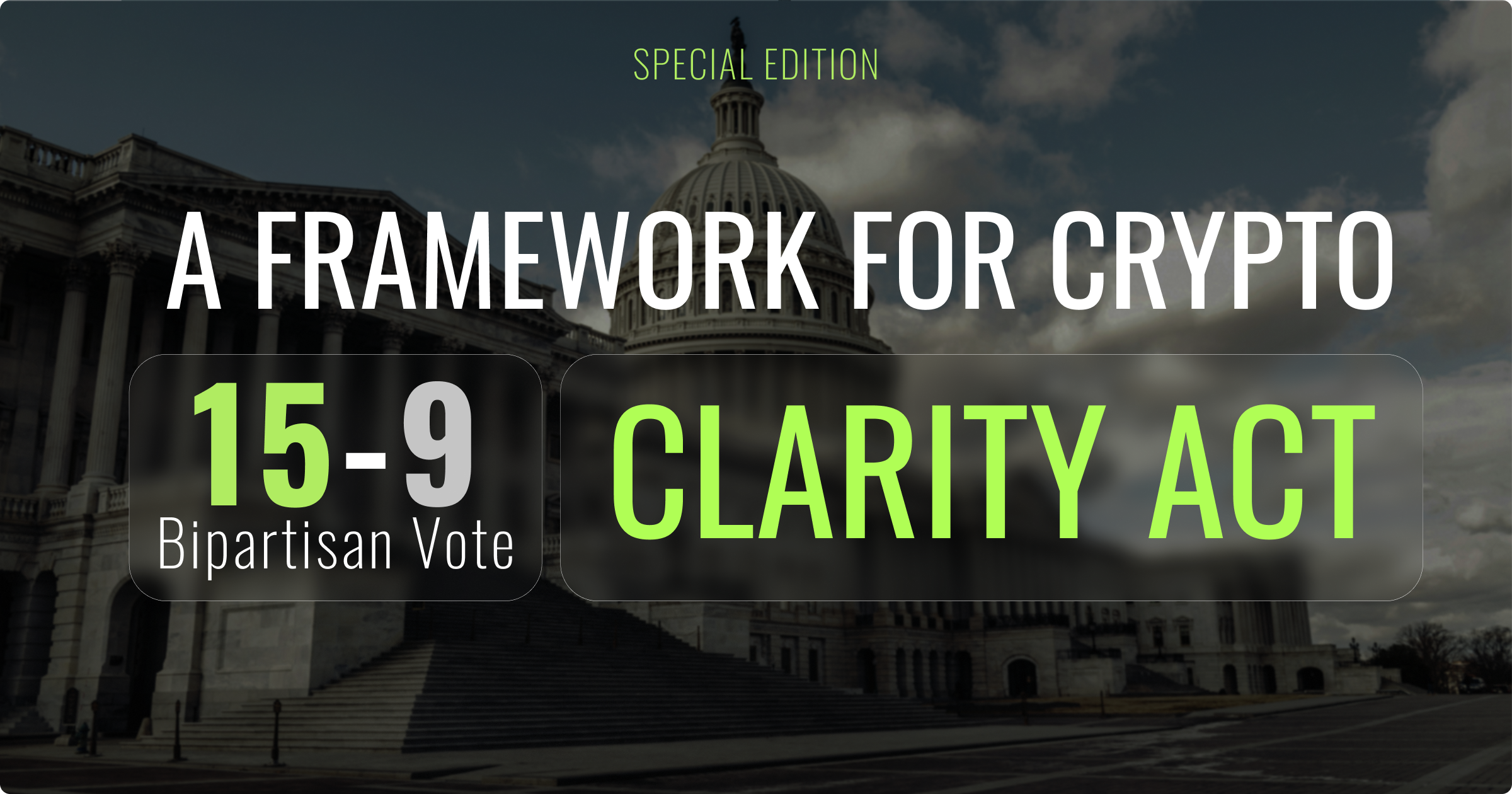
This week, May 14, 2026, the U.S. Senate Banking Committee delivered a historic bipartisan vote, advancing the Digital Asset Market Clarity Act of 2025 (CLARITY Act) out of committee by a 15-9 margin. All Republicans on the committee were joined by two Democrats - Sens. Ruben Gallego (D-AZ) and Angela Alsobrooks (D-MD) in support. The bill, which passed the House of Representatives in July 2025 by a strong 294-134 vote, now moves closer to the full Senate floor.
Why This Matters
In our view this is the most comprehensive federal framework yet for digital assets. We believe it draws clear jurisdictional lines between the SEC and CFTC, introduces a workable decentralization test for classifying network tokens as non-securities, provides meaningful protections for developers and DeFi infrastructure, and establishes balanced rules for intermediaries, stablecoins, and customer safeguards. After months of negotiations addressing stablecoin yields, illicit finance concerns, and developer protections, the May 12 revised 309-page text reflects real compromise across the aisle.
Key Pillars of the The Clarity Act
This 309 page draft from May resolves most of the issues that derailed the January attempt. The CLARITY Act organizes its framework into nine titles that together resolve long-standing regulatory ambiguity:
SEC/CFTC Jurisdiction and Token Classification (Title I): It creates a “coordinated control” test (building on earlier “common control” concepts) to determine when a network token is no longer a security. A 49% beneficial ownership threshold plus decentralized governance carve-outs help mature blockchain systems transition to commodity status. Ancillary asset originators face a tailored disclosure regime, while secondary-market trading of commodity-like tokens receives clear treatment under insider trading and fiduciary rules. For tokenization platforms like Ondo, which is building the bridge between U.S. Treasuries and onchain markets, the clearer line between securities and digital commodities reduces the legal ambiguity that has slowed institutional onboarding.
DeFi and Decentralized Innovation (Title III): The bill distinguishes “decentralized ledger finance trading protocols” from centralized ones via objective exclusionary tests. Validators, sequencers, oracle providers, node operators, and even incident-response councils are explicitly carved out from certain obligations. This is a major win for non-custodial innovation while preserving AML/BSA obligations for centralized platforms.
Developer Protections (Title VI): The Blockchain Regulatory Certainty Act (BRCA) is preserved and strengthened. Non-controlling software developers receive safe harbors from money-transmitter status and certain criminal transmission liabilities (with narrow carve-outs for knowing facilitation of crime). An NFT safe harbor rounds out developer-friendly provisions.
Stablecoins and Banking Innovation (Title IV): Following the Tillis-Alsobrooks compromise, the bill prohibits payments on stablecoin balances that are “economically or functionally equivalent to interest on bank deposits.” Importantly, it carves out bona fide activity-based rewards (staking, liquidity provision, governance) that can be calculated by balance, duration, or tenure. Banks gain clearer authority for digital asset activities, with joint rulemaking on capital, margining, and netting.
Additional Safeguards: Strong illicit-finance provisions align with Bank Secrecy Act standards and include studies on mixers. Insolvency safe harbors (Title VII) extend bankruptcy protections to digital commodity transactions, enabling institutional prime brokerage and clearing markets to develop at scale. For institutional custodians like BitGo and Anchorage, which have spent more than a decade building the qualified custody, lending, and settlement rails for the industry, this is the legal foundation that makes the next phase of growth possible.
These elements strike a balance: robust consumer and national-security protections alongside space for responsible innovation. Our team at Pantera summarized it well:


What’s Next
While the CLARITY Act’s markup by the Senate Banking Committee is a major milestone, the bill is not yet law. It still requires full Senate passage (likely needing 60 votes), reconciliation with the parallel Agriculture Committee text, and final House concurrence before reaching the President’s desk. Some Democrats, including Sen. Gallego, have signaled that further progress on ethics guardrails for public officials could influence their floor votes. White House support and industry momentum remain strong, however, and analysts see a realistic path to enactment this year.
What This Means for the Industry
For builders, investors, and institutions, the CLARITY Act represents the regulatory certainty we’ve long advocated for. It reduces enforcement risk for decentralized protocols, unlocks institutional capital through safe harbors and clear commodity status, and positions the United States as the global leader in responsible crypto innovation. By giving banks and intermediaries workable rules while shielding genuine DeFi and developer activity, the bill creates the foundation for the next phase of mainstream adoption without sacrificing the permissionless ethos that makes blockchain powerful.
At Pantera, we’ve always believed that smart, predictable regulation accelerates capital formation and technological progress. The vote is tangible proof that Washington is finally catching up to where the market and the technology already are.
We’ll continue tracking developments closely as the bill advances. The next few months could be among the most consequential in crypto’s regulatory journey.
Our View
We’ve held a consistent thesis at Pantera: durable U.S. capital flows into digital assets require durable U.S. rules. The GENIUS Act gave us stablecoins. CLARITY gives us the market structure. Together, they are the regulatory predicate for the next decade of institutional adoption for tokenization (Ondo, BUIDL), for digital commodity prime brokerage and custody (BitGo, Anchorage), for the integration of onchain financial infrastructure with the traditional system.
As Senator Alsobrooks put it during the markup: “This digital revolution is happening with us or without us.” Washington finally seems to realize that it’s better to have it happen with rules than without them.
Today wasn’t the finish line and we need everyone’s support to get us there.
Let’s Meet Up
Santa Fe, New Mexico, May 18-19
NYC, June 17-18
Important Disclosures – Certain Sections of This Letter Discuss Pantera’s Advisory Services and Others Discuss Market Commentary. Certain sections of this letter discuss the investment advisory business of Pantera Capital Partners LP and its affiliates (”Pantera”), while other sections of the letter consist solely of general market commentary and do not relate to Pantera’s investment advisory business. Pantera has inserted footnotes throughout the letter to identify these differences. This section provides educational content and general market commentary. Except for specifically-marked sections of this letter, no statements included herein relate to Pantera’s investment advisory services, nor does any content herein reflect or contain any offer of new or additional investment advisory services. This letter is for information purposes only and does not constitute, and should not be construed as, an offer to sell or buy or the solicitation of an offer to sell or buy or subscribe for any securities. Opinions and other statements contained herein do not constitute any form of investment, legal, tax, financial, or other advice or recommendation.
thank you for the writeup, paul. honestly needed this one. curious which part of the bill you think shifts builder behavior fastest once it actually lands?