

Summary
AI and blockchain are converging across four pillars: payments, identity, open systems, and resource aggregation. Each is already in production, with Pantera portfolio companies active across all four verticals.
The philosophical fit is clean: AI is abundance (infinite content, infinite agents), blockchain is scarcity (verifiable ownership, native settlement). One generates, the other authenticates and pays.
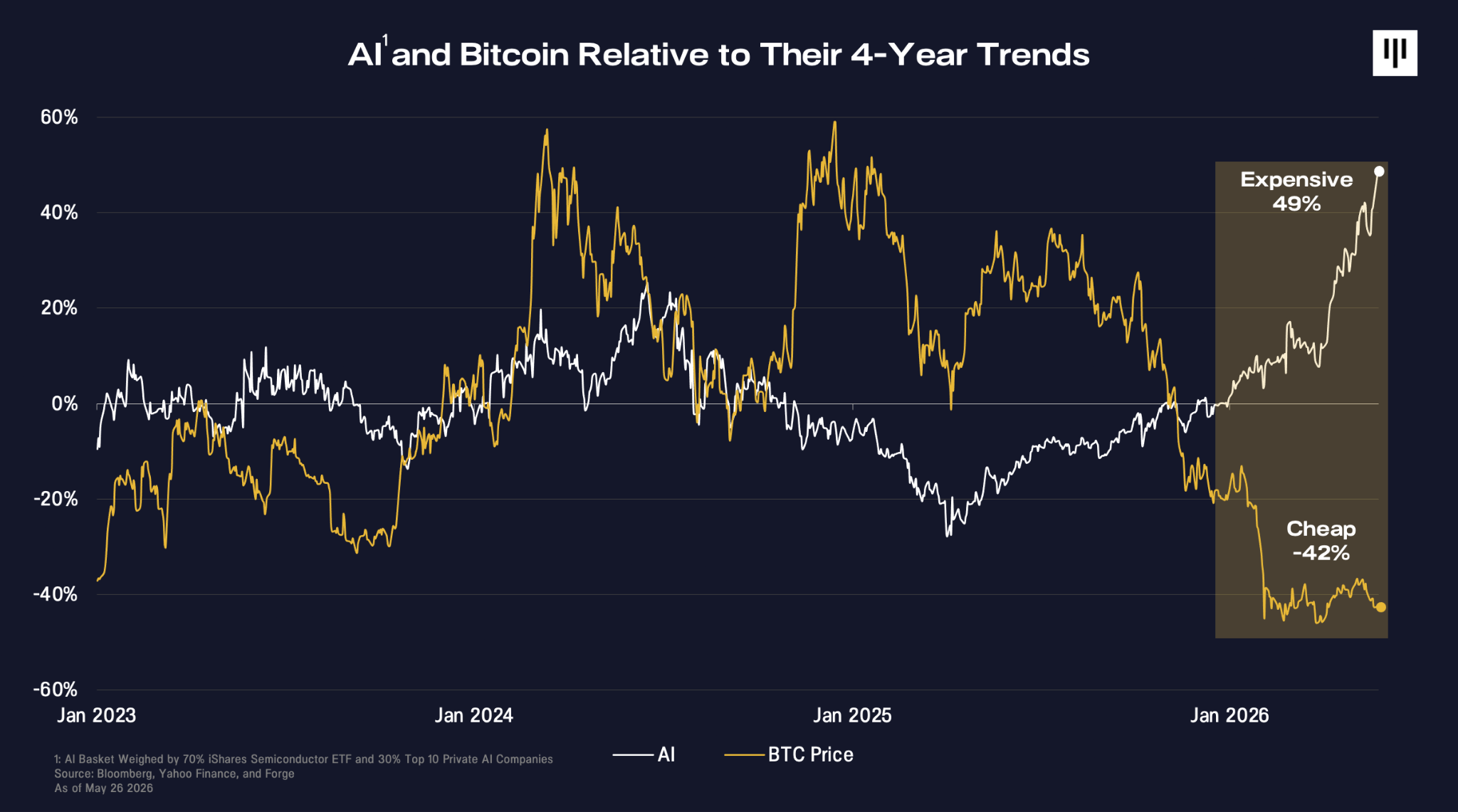
Markets are not pricing this in. A Pantera index of ten leading AI companies shows the largest valuation divergence between AI and crypto we’ve ever seen, despite the two being linked.
AI agents will not open bank accounts, use Fedwire, or wait on ACH. They will transact on-chain, in stablecoins, at machine speed. The agent economy is being built on rails most institutional investors haven’t allocated to.
Today, the world is rightfully captivated by Artificial Intelligence. But AI is only half the story. The next great technological convergence is quietly taking shape at the intersection of AI and Blockchain. While capital has flooded frantically into public and private AI rounds, pushing top AI companies into highly overbought territory, crypto remains a fundamentally undervalued, trend-adjusted vehicle to play the exact same long-term tech transformation.
The real excitement isn’t in either technology alone but how they reinforce each other. For years, AI and crypto have been treated as separate megatrends. But they’re actually the same trend viewed from two different angles.
AI is creating a new class of economic actors: autonomous agents that need to own assets, transact value, coordinate, and interact at scale. Crypto (and blockchain more broadly) is the only financial and coordination infrastructure built from the ground up to serve non-human counterparties. Agents and bots are already first-class citizens on blockchain networks, which is why we believe the overwhelming majority of future agent-driven transactions will happen on-chain.
This convergence is one of Pantera’s highest-conviction research and investment themes right now. We’re dedicating significant time and capital to it.
What History Tells Us
History shows that the biggest economic leaps happen when two powerful technologies meet: Steam + railroads. Electricity + manufacturing. Internet + smartphones. Each time, a powerful new capability paired with enabling infrastructure created entirely new economies and enduring companies.
AI delivers indefinite abundance — intelligence, content, agents, and digital identities at near-zero marginal cost. Blockchain delivers definite scarcity — verifiable ownership, trust-minimized coordination, and cryptographic truth. As Dan Morehead and Cosmo Jiang outlined in our latest Pantera Blockchain Letter, the talent overlap is massive (both rooted in math and open-source culture), and philosophically they are yin and yang: AI creates indefinite abundance; blockchain enforces definite scarcity.
I recently sat down with Alex Odagiu of YZi Labs at their Convergence Summit to unpack exactly this macro shift how AI agents need programmable trust on blockchain, the role of stablecoins and tokenization, and why the agent economy is coming fast. Watch here:

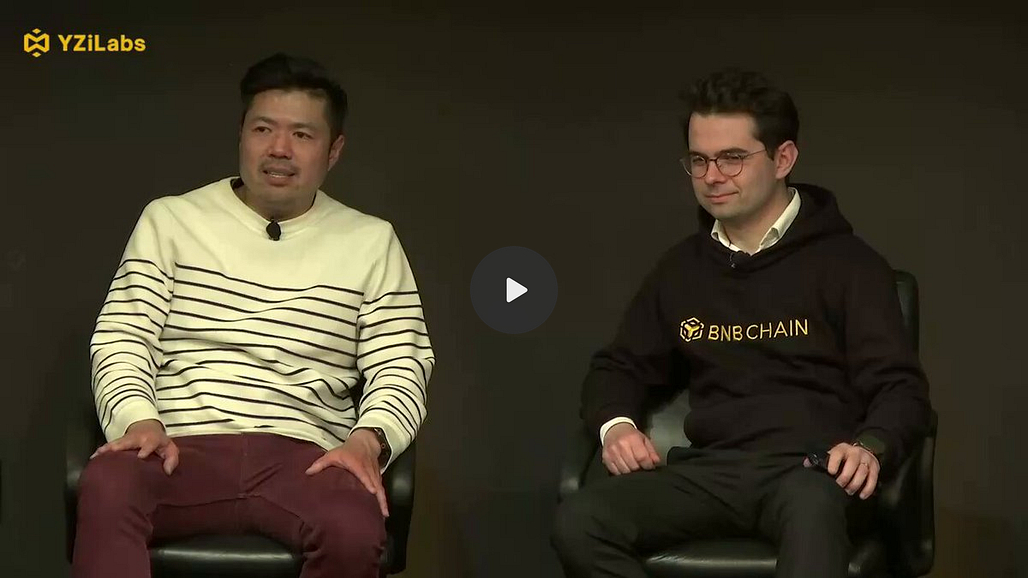

Source: YZi Labs, May 2026 Convergence Conference
Current Use Cases of This Convergence
AI Agents Need Machine-Native Finance
Our current financial system was designed for human users, slow, permissioned, and reliant on centralized intermediaries. We’re now entering an era that demands infrastructure built for a new class of users: AI agents. Blockchain is the efficient solution at scale.
Trading and Payments
Companies are already proving this works today. Our portfolio company OpenFX is processing over $60 billion in annualized TPV using stablecoins as the settlement layer. They’re very explicit: the next wave of users isn’t humans — it’s software. AI agents are expected to become the largest category of FX users within a decade.
Agents don’t need bank accounts, Fedwire, or SWIFT. They need fast, cheap, permissionless, 24/7 rails with programmatic settlement. That’s exactly what blockchain provides.
Spotlight on another portfolio leader enabling this future: Alchemy, the “AWS of Web3” and core developer platform now powering the next generation of AI + crypto applications. From agent-native wallets to on-chain execution layers, Alchemy is making it radically easier for developers to build the infrastructure agents will actually use.
The Critical Need for Proof of Personhood & Identity
In a world flooded with AI agents and synthetic media, distinguishing between humans, machines, and AI-generated content is becoming essential.
Traditional identity systems (passports, government records, bank accounts) were built for centralized human interactions and don’t translate well to this new reality. What we need is a global, cryptographically secure, privacy-preserving, censorship-resistant way to prove identity attributes on the internet.
That sounds like blockchain.
One of our portfolio companies leading here is World (formerly Worldcoin). World is scaling a global privacy-preserving identity and financial network through Proof of Personhood — cryptographically proving an individual is both human and unique.
Users verify via iris scan with the World Orb biometric device.
They receive a World ID, hashed and secured on Worldchain.
World has now surpassed 18 million unique verified humans and ranks among the top 5 most used blockchains.
Recent enterprise partnerships highlight growing real-world utility in the latest Stateful Podcast by Pantera: Tinder (combating fake profiles), Reddit (filtering for verified humans only), and Zoom (Deepfake integration for identity verification in video calls).

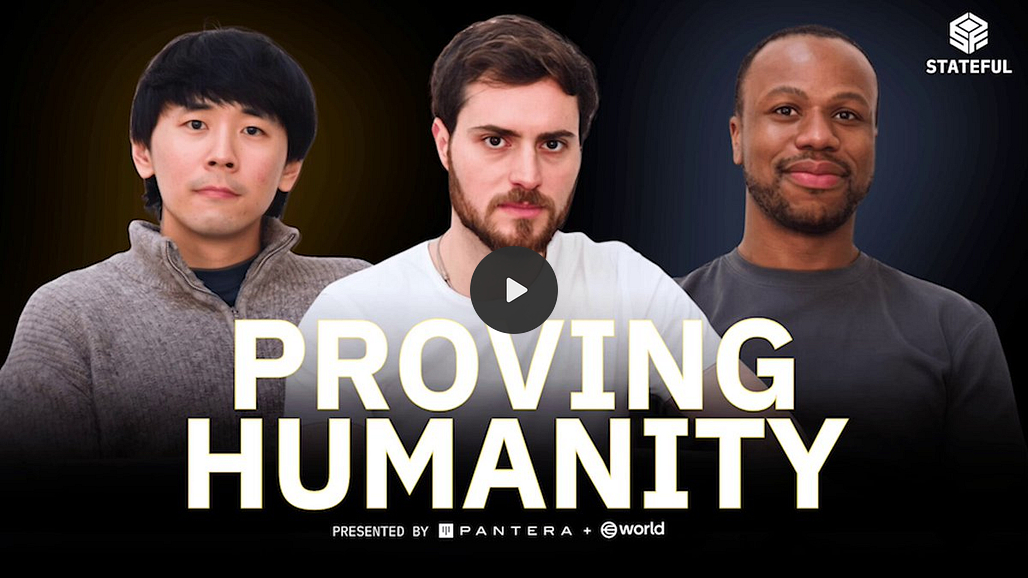
Sam Altman co-founded World alongside his work at OpenAI, recognizing the identity challenges his own company’s technology would create.
We’re also backing TransCrypts, which is building the blockchain layer for self-sovereign identity and verifiable credentials. Their platform gives users true ownership of verified records (employment, income, credentials) on-chain — a powerful weapon against AI-driven fraud, deepfakes, and synthetic identity attacks. In an agent-heavy world, this kind of programmable trust becomes table stakes.
AI Overbought, Crypto Undervalued
While AI valuations have surged, crypto has pulled back — creating one of the most compelling relative value opportunities we’ve seen.
As of May 2026, leading AI indices are trading roughly 49% above their four-year trend line. Bitcoin sits roughly 42% below its long-term trend. This is the widest divergence in history, despite the deep linkage between the two: AI agents will run on crypto rails.
Deals at this intersection are increasingly competitive. But Pantera has been investing in blockchain for 13+ years. That long-term presence, deep relationships, and pattern recognition across cycles give us a real edge in sourcing and winning the best opportunities.
As Robbie Mitchnick of BlackRock recently emphasized: AI agents won’t use traditional banking infrastructure — they’ll use blockchain-based monetary instruments. Crypto is machine-native money for the machine intelligence economy.
Founders: This Is Your Moment
To the builders reading this: the convergence isn’t coming, it’s already here.
AI agents need rails that traditional finance was never designed to provide. They need identity systems that can prove humanity and attributes without centralized gatekeepers. They need verifiable credentials, programmable money, and developer infrastructure that treats agents as first-class citizens.
The infrastructure layer (Alchemy, World, TransCrypts, OpenFX, and others in the Pantera portfolio) is maturing fast. Regulatory tailwinds are strengthening. Capital is starting to recognize the relative value.
If you’re building at the intersection agent-native finance, decentralized identity, verifiable AI outputs, on-chain coordination for autonomous systems — now is the time. The market is still early, the technical primitives are ready, and the demand is exploding.
We’ve been in this space for over a decade precisely so we can back the founders who see what’s next. If you’re one of them, reach out. Pantera is actively investing in this thesis through our funds.
Pantera News
The Convergence of AI and Blockchain — Pantera Blockchain Letter, May 2026 Dan Morehead and Cosmo Jiang lay out the macro case for the AI x Blockchain convergence in this month’s Blockchain Letter. The piece covers the historic valuation divergence between leading AI companies and Bitcoin and what it means for institutional allocators.
Pantera’s AI x Blockchain Thesis — Fortune Brand Studio Cosmo Jiang sits down with Fortune to discuss why proof of personhood and verifiable on-chain identity become essential infrastructure as autonomous AI agents move into the digital economy. Pantera portfolio companies World, TransCrypts, and Solana are building the rails.
State of Tokenization Q1 2026 Report – Pantera Research Lab Pantera Research Lab publishes its State of Tokenization report to answer the question every bank is now facing: how much tokenization is real on-chain infrastructure and how much is just a “newspaper-on-a-website.” The State of Tokenization portal and Tokenization Progress Index track 593 assets across a $320.6B market to separate genuine maturity from hype.
Business
OpenFX Crosses $45B in Annualized Stablecoin Settlement Volume Pantera portfolio company OpenFX has scaled from $4B to over $45B in annualized cross-border payment volume using stablecoins as the underlying settlement rail, with 98% of transactions clearing in under 60 minutes. The team has been explicit that the next wave of users is not human — software agents will be the largest FX category within a decade.
Visa Expands Stablecoin Settlement to 100+ Countries Visa’s stablecoin settlement run rate continues to climb, with crypto chief Cuy Sheffield framing card rails and crypto rails as complementary rather than competing. The expanded program now live in 18 countries and targeting 100+ by year-end supports on-chain settlement through Bridge and Lead Bank.
Grass Enhances AI Data While Rewarding Validators Grass crowdsources idle bandwidth to collect web data for training AI. With 2.5 million nodes across 190 countries, it’s a clean example of DePIN functioning as AI infrastructure.
Regulation
SEC and CFTC Issue Joint Interpretive Release Classifying BTC, ETH, and SOL as Commodities On March 17, the SEC and CFTC jointly released a 68-page binding interpretive rule establishing the first formal five-category token taxonomy in U.S. history, explicitly classifying 16 assets — including BTC, ETH, and SOL — as digital commodities. For AI x blockchain specifically, classifying ETH and SOL removes the regulatory overhang on the two leading agent-economy chains.
SEC Innovation Exemption Proposal Advances to White House Review Chairman Atkins’s sandbox framework — now under OIRA review — would let eligible companies issue tokens and launch on-chain products without full SEC registration for a defined period. This is the catalyst that opens U.S. distribution for tokenized ETFs, agent wallets, and identity primitives being built today.
CLARITY Act Advances Toward Senate Banking Committee Markup A bipartisan stablecoin yield compromise from Senators Tillis and Alsobrooks cleared the last major obstacle to a Banking Committee markup, which was scheduled for May 14. If CLARITY passes, the March 17 commodity classifications get codified into permanent statute - a structural unlock for the institutional capital still sitting on the sidelines.
New Products and Deals
World Launches AgentKit: Proof of Human for the Agentic Web World’s AgentKit lets developers build agentic products that can verify whether a counterparty is a unique human, directly addressing the bot-and-deepfake problem at the protocol level. The network now counts 18 million verified humans across 160 countries, with launch integrations spanning Tinder, Zoom, DocuSign, and Okta.
OpenMind Launches Open Robotics Coordination Protocol With Unitree Pantera portfolio company OpenMind kicked off live pilots with Unitree on a shared coordination protocol for autonomous machines. As Tesla, Amazon, Unitree, and Figure all ship at scale, OpenMind is building the common language they will use to talk to each other.
GeoNet Surpasses 21,000 Stations, 3x Its Largest Competitor GeoNet now has three times more GPS reference stations than the combined network of its $10B incumbent competitors Trimble and Hexagon, with annualized revenue up from $3M to $7M year-over-year. 2.6 million acres have already been sprayed by AI-powered autonomous tractors running on GeoNet RTK.
Let’s Meet Up
LA, June 8-9
NYC, June 17-18
Important Disclosures – This letter is for informational and educational purposes only and does not constitute, and should not be construed as, an offer to sell or buy or the solicitation of an offer to sell or buy or subscribe for any securities. Opinions and other statements contained herein do not constitute any form of investment, legal, tax, financial, or other advice or recommendation. Nothing in this letter should be construed as investment advice
The portfolio companies mentioned, referred to, or described herein are included for illustrative purposes only and are not representative of all investments in vehicles managed by Pantera Capital Partners LP and its affiliates (”Pantera”) and there can be no assurance that the investments will be profitable or that other investments made in the future will have similar characteristics or results.