

Summary
Franklin Templeton and Ondo Finance have tokenized five ETFs — spanning U.S. equities, fixed income, and gold — available 24/7 through crypto wallets, with no brokerage account required. The partnership is the largest institutional endorsement of on-chain securities distribution to date.
Ondo Global Markets now controls roughly 70% of the tokenized equity market, with over $700M in TVL and $13B in cumulative trading volume since launching in September 2025. Franklin Templeton brings $1.7T in AUM; Ondo brings the rails.
This is Crypto as a Service in its clearest form yet. The user just invests in the world’s most in-demand assets. The fact that it runs on-chain is infrastructure, not identity.
For years, the pitch for tokenized real-world assets was straightforward in theory and messy in practice: put traditional financial products on-chain, unlock 24/7 liquidity, and reach a global audience that doesn’t have access to U.S. brokerage infrastructure. The pitch was right. The execution kept lagging.
This week, something changed.
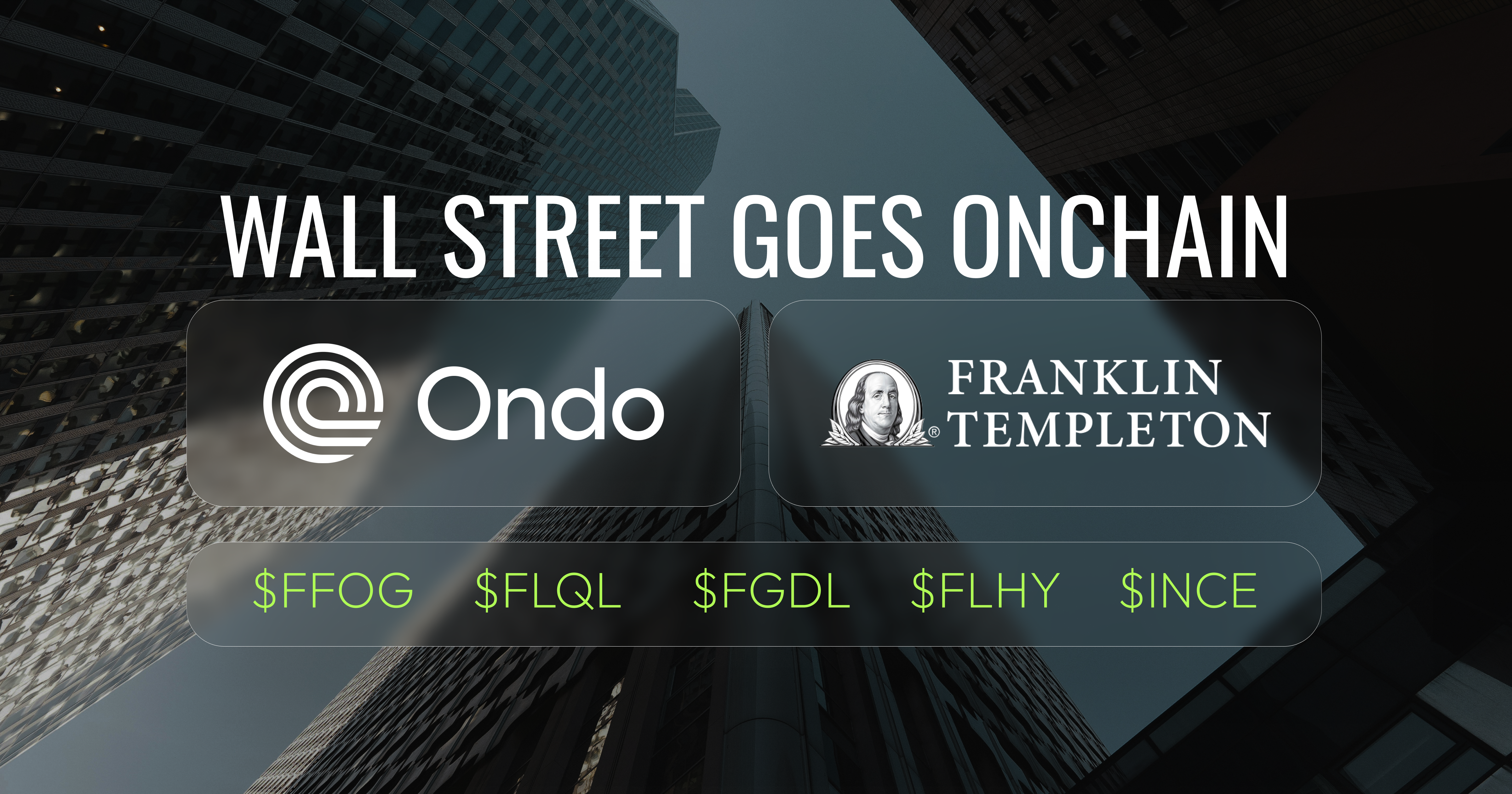
Franklin Templeton, a 79-year-old institution managing over $1.7 trillion in assets, announced it is partnering with Ondo Finance to tokenize five of its ETFs, distributing them directly onchain via Ondo Global Markets and making them accessible through decentralized and centralized exchanges, and crypto wallets. No brokerage account. No trading hour restrictions. No intermediary standing between the investor and the tokenized asset.
This is not a proof of concept. It’s a model that many other asset managers will follow.
What Ondo and Franklin Templeton Are Building Together


Under the arrangement, Ondo purchases shares of the Franklin ETFs and issues tokens through a special-purpose vehicle. Investors hold rights to the return stream and not the underlying shares, which frees those tokens to be used as collateral or plugged directly into DeFi applications. Franklin Templeton manages the funds. Ondo provides the rails. The five ETFs now available on-chain:
Franklin Focused Growth ETF (FFOG) — actively managed U.S. equity, focused on innovative and growth-oriented companies
Franklin U.S. Large Cap Multifactor Index ETF (FLQL) — systematic large-cap exposure using a multifactor approach
Franklin Responsibly Sourced Gold ETF (FGDL) — gold bullion sourced through responsible supply chains
Franklin High Yield Corporate ETF (FLHY) — U.S. high yield corporate bond exposure
Franklin Income Equity Focus ETF (INCE) — equity strategy focused on income-oriented securities
These products are initially available in Europe, Asia-Pacific, the Middle East, and Latin America. U.S. availability awaits further regulatory clarity on how third parties can distribute registered funds onchain; a signal that the regulatory conversation is progressing.

In the latest episode of Pantera’s Stateful podcast, Franklin Templeton’s Sandy Kaul and Ondo Finance’s Ian De Bode joined Franklin Bi, General Partner at Pantera to discuss how onchain capital markets are taking shape, from Ondo’s permissionless, 24/7 tokenized ETFs functioning as live DeFi collateral to the longer-horizon reality of AI agents needing blockchain rails to settle transactions at scale.
Why This Is a Crypto as a Service Moment, Not Just an RWA Headline
In my last newsletter, I wrote about the defining thesis for 2026: we are moving from Crypto as a Sector to Crypto as a Service (CaaS). The goal is no longer for users to see the blockchain. The goal is for them to forget it’s even there.
The Ondo x Franklin Templeton partnership is the clearest institutional proof of that thesis I’ve seen.
Think about what’s actually happening here. A retail investor in Singapore or São Paulo opens a crypto wallet and gains access to a Franklin Templeton growth ETF. They’re not thinking about tokenization. They’re not thinking about SPVs or smart contracts. They’re thinking: I can finally gain exposure in U.S. equities at 2am on a Sunday without opening a brokerage account. The blockchain is the infrastructure. The experience is simply investing.
Sandy Kaul, Franklin Templeton’s head of innovation, described the initiative as a test case for “what is really striking the appetite of a new audience.” I’ve heard Sandy use this exact framing before — in fact, in my February piece RWA Is the Gold Rush, I quoted her on just how difficult it is to move from an account-based system to a wallet-based system. That she’s now helping lead the charge on exactly that transition is notable. The new audience isn’t looking for crypto exposure. They already have that. They want diversification, yield, and access to assets that have historically been gated by geography and brokerage infrastructure. Tokenization removes those gates.
This is also the realization of a prediction I made in 8 Predictions for 2025: that RWAs would finally expand beyond the basic products — T-bills, money market funds — into more complex instruments like stocks, ETFs, and bonds, as the infrastructure to mint and maintain them matured. That infrastructure is now here. And Ondo built it.
The Scale of What Ondo Has Built
Pantera has been an early investor in Ondo since before the tokenized treasury market reached $850M — we wrote about the thesis here. I led Pantera’s seed investment back in 2021 and today, Pantera is the largest shareholder in Ondo. Since launching Ondo Global Markets in September 2025, the platform has accumulated over $700M in TVL and powered more than $13 billion in trading volume across 70,000+ cumulative holders. The broader tokenized equity market stands at roughly $950 million as of March 2026, meaning Ondo controls approximately 70% of the category and more than all competing platforms combined. This is a huge testament to Nathan and the entire Ondo team!

Last year, Franklin laid out the structural case: tokenization is expanding the footprint of capital markets to be truly global for the first time - Great Onchain Migration Blockchain Letter.
The Franklin Templeton partnership is the most powerful validation of that thesis yet. When the largest asset manager to directly support on-chain distribution chooses your infrastructure, the market takes notice. BlackRock, NYSE, and others are watching. This is becoming the default model for how traditional finance enters the on-chain world.

For a deeper look at how Pantera has been thinking about the RWA category,this conference call with Ondo’s Nathan Allman and Figure’s Mike Cagney is worth your time.
What Comes Next
The immediate question is U.S. availability. Franklin Templeton has been transparent that domestic access depends on further regulatory clarity; a reasonable constraint, and one that is actively being worked through. As I wrote in Navigating Crypto in 2026, tokenized stocks and equities could grow even faster once the anticipated innovation exemption under the SEC’s Project Crypto debuts. That window is coming.
Longer term, the structural implications are significant. If tokenized ETFs can be used as on-chain collateral, which this structure enables, they become native financial primitives, not just digital mirrors of traditional products. A tokenized Franklin ETF held as collateral in a DeFi protocol is a fundamentally different financial object than an ETF sitting in a Schwab account. That composability is what makes this more than a distribution story. It is the beginning of a new financial stack.
- Paul Veradittakit
Pantera News
OpenFX Funding Announcement
Pantera led OpenFX’s Series A round as the company works to replace fragmented, multi-day FX settlement with a single API that routes cross-border payments 99% faster and 99% cheaper than legacy rails.
The Financial Rails of Agentic Commerce
Pantera’s Cosmo Jiang goes deep on how AI agents are becoming autonomous economic actors — and why crypto rails, stablecoins, and payment standards like x402 are the infrastructure they run on.
Business
Visa Crypto Chief Bets on Stablecoin Settlement
Visa’s stablecoin settlement volumes have reached a $4.5B annualized run rate, growing significantly month over month according to Visa’s head of crypto Cuy Sheffield. His framing — that companies building stablecoin products still need Visa’s merchant network — positions crypto rails and card rails as complementary infrastructure, not competing ones.
Mastercard Launches Crypto Partner Program With 85+ Firms
Binance, Circle, Gemini, PayPal, Paxos, Ripple, BitGo, and Crypto.com are among the participants, focused on cross-border transfers, B2B payments, and global payouts. When Mastercard organizes 85 companies under one program, the “crypto as infrastructure” thesis stops being speculative.
BlackRock Launches Staked Ethereum ETF (ETHB)
BlackRock’s iShares Staked Ethereum Trust debuted on Nasdaq on March 12 with $107M in seed assets, distributing 82% of staking rewards monthly to investors. It’s the first yield-generating crypto ETF from the world’s largest asset manager — and a template that now applies to every proof-of-stake chain.
Regulation
SEC and CFTC Issue Landmark Joint Interpretive Release
The March 17 release established a five-category crypto taxonomy — digital commodities, collectibles, tools, stablecoins, and securities — and classified 16 assets including BTC, ETH, and SOL as commodities under CFTC jurisdiction. This directly clears the runway for the Ondo x Franklin Templeton model to eventually reach U.S. investors.
Kraken Becomes First Digital Asset Bank to Receive a Federal Reserve Master Account
Kraken Financial now has direct access to Fedwire — the interbank network that moves trillions daily — making it the first crypto-native company to gain direct Fed access. It sets a precedent that will matter for every institutional crypto product that follows.
GENIUS Act Clears Its Last Major Hurdle
A Senate stablecoin yield compromise was reached on March 20, removing the key obstacle to a Banking Committee markup targeted for late April. If the CLARITY Act follows, the March 17 commodity classifications get codified into permanent statute.
SEC Innovation Exemption Proposal Submitted to the White House
Chairman Atkins submitted a sandbox proposal that would let eligible companies issue tokens and launch on-chain products without full SEC registration for a limited period. This is the “innovation exemption” I flagged in Navigating Crypto in 2026 as the catalyst for accelerating tokenized equity distribution in the U.S.
New products and deals

Surf Studio Launch: Build Custom Crypto Dashboards and Apps With Just a Prompt
Surf , the crypto-native AI platform and Pantera portfolio company launched Surf Studio, a no-code environment that lets anyone build Web3 dashboards, portfolio trackers, and crypto apps from a plain-language prompt. No engineers, no designers: describe what you need, Surf builds it. The platform spans 40+ blockchains, 29.4B token transfer records, and 120M+ indexed social posts. Try it out.
SoFi and Mastercard Partner to Enable SoFiUSD Across the Global Payments Network
SoFiUSD is now enabled as a settlement currency across Mastercard’s network — covering card-based transactions, cross-border remittances, and B2B transfers, with support planned for Mastercard’s Multi-Token Network. Two of the world’s largest financial rails are now actively integrating bank-issued stablecoins.
TCS Blockchain and PayPal USD Bring On-Chain Settlement to Freight Invoicing
Carriers in the $3T North American trucking industry have historically surrendered up to 30% of net revenues to factoring companies just to get paid. TCS and PayPal USD are settling freight invoices on-chain and cutting out those intermediaries — CaaS where the end user is a trucker, not a crypto trader
Let’s Meet Up
Bangkok, April 21-23
Miami, May 5-7
Park City, May 13-15
Important Disclosures – Certain Sections of This Letter Discuss Pantera’s Advisory Services and Others Discuss Market Commentary. Certain sections of this letter discuss the investment advisory business of Pantera Capital Partners LP and its affiliates (”Pantera”), while other sections of the letter consist solely of general market commentary and do not relate to Pantera’s investment advisory business. Pantera has inserted footnotes throughout the letter to identify these differences. This section provides educational content and general market commentary. Except for specifically-marked sections of this letter, no statements included herein relate to Pantera’s investment advisory services, nor does any content herein reflect or contain any offer of new or additional investment advisory services. This letter is for information purposes only and does not constitute, and should not be construed as, an offer to sell or buy or the solicitation of an offer to sell or buy or subscribe for any securities. Opinions and other statements contained herein do not constitute any form of investment, legal, tax, financial, or other advice or recommendation.
great piece! we've been seeing RWA come up more and more across the VC newsletters we track, this deal is probably why